
UI Creative Friday — Lunar Robot in Twin
Project type: Internal creative exploration / UI-UX concept
My role: Concept direction, UX/UI design, interaction flow
Tools: Figma, Blender, Photoshop
Duration: 2 Fridays (Creative Friday sprint)
Outcome: Present the prototype in the Sprint Demo as inspiration.
Background
Every month, our design department holds a Creative Friday — a short, fun challenge where we experiment, share ideas, and push design boundaries beyond daily projects.
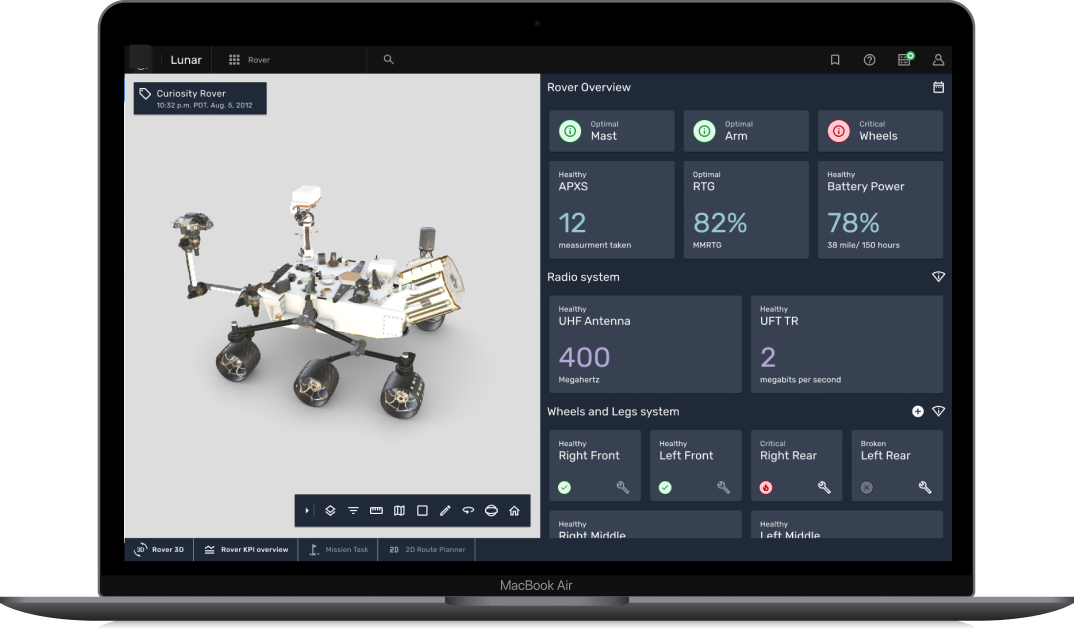
For this round, I wanted to explore how digital twins and space exploration could merge into an immersive and informative interface. The idea: what if we could visualize a lunar rover in a digital twin — managing its systems, planning routes, and observing mission data — all inside one unified experience?
The goal wasn’t delivery, but discovery — to learn, play, and stretch our visual and UX imagination.

The Creative Challenge
“How might we design a twin interface that feels both scientific and cinematic — something that invites exploration instead of just reporting data?”
In most industrial dashboards, the 3D model, the sensor data, and the task planner live in separate places. I wanted to bring them together — so a user could:
• See the rover in real-time 3D,
• Plan exploration routes on a 2D map, and
• Monitor system health through an interactive dashboard —
all within the same visual space.
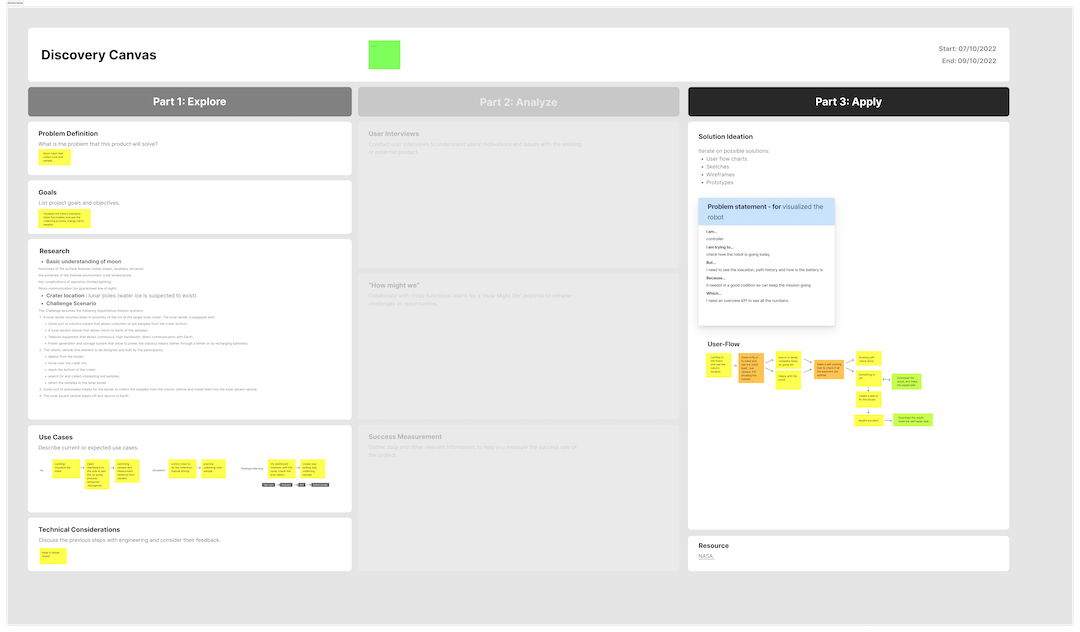
Discovery Canvas
Before jumping into visuals, I created a Discovery Canvas to define what we were actually exploring during this Creative Friday. Even though this was a fun internal activity, applying a lightweight discovery framework helped focus creativity and align ideas.
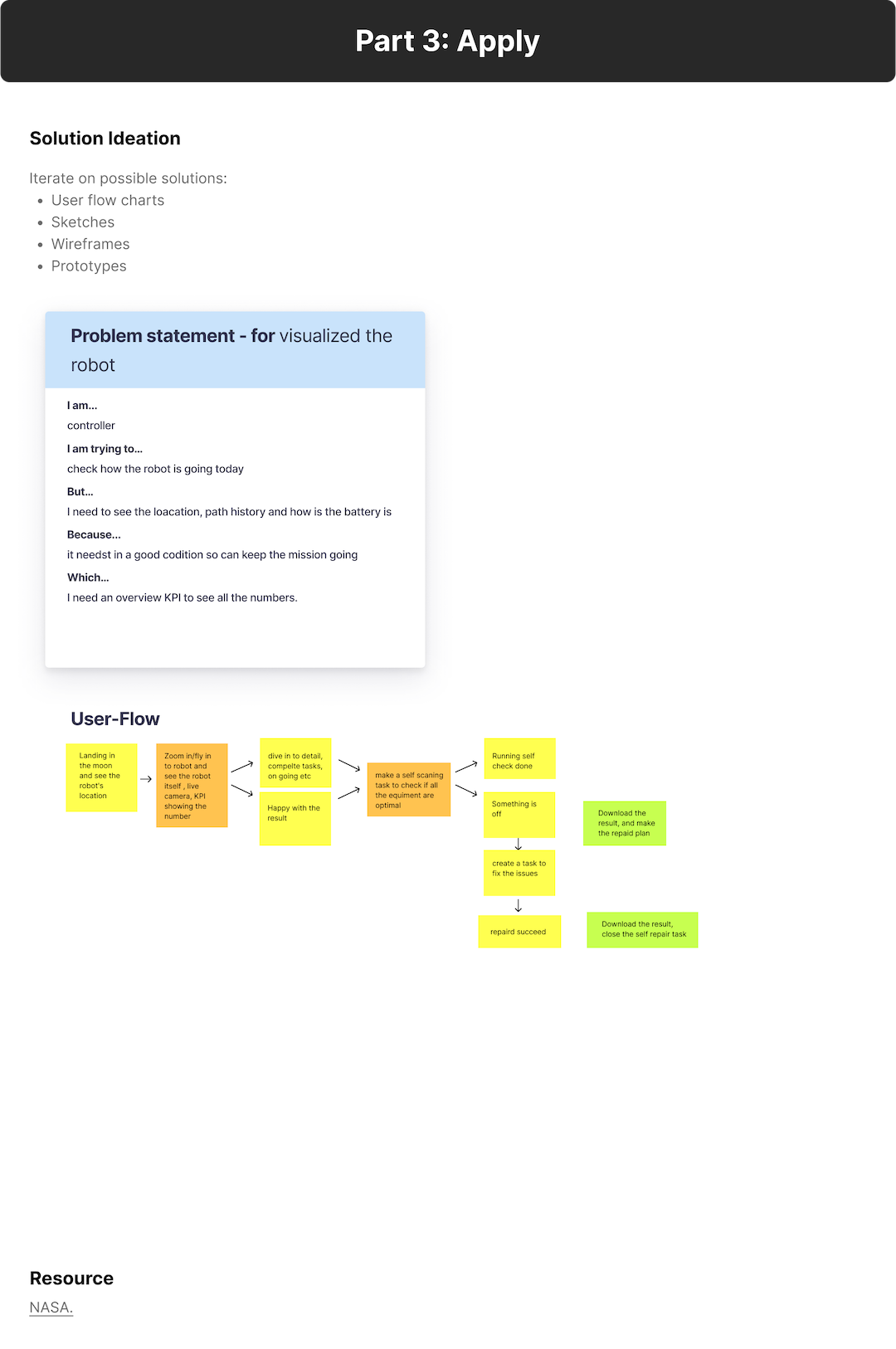
I started by outlining a simple problem definition:
“I am a rover operator who wants to understand the rover’s location, system health, and power usage at a glance — so I can keep the mission running smoothly without switching between multiple dashboards.”
From there, we mapped key areas:
-
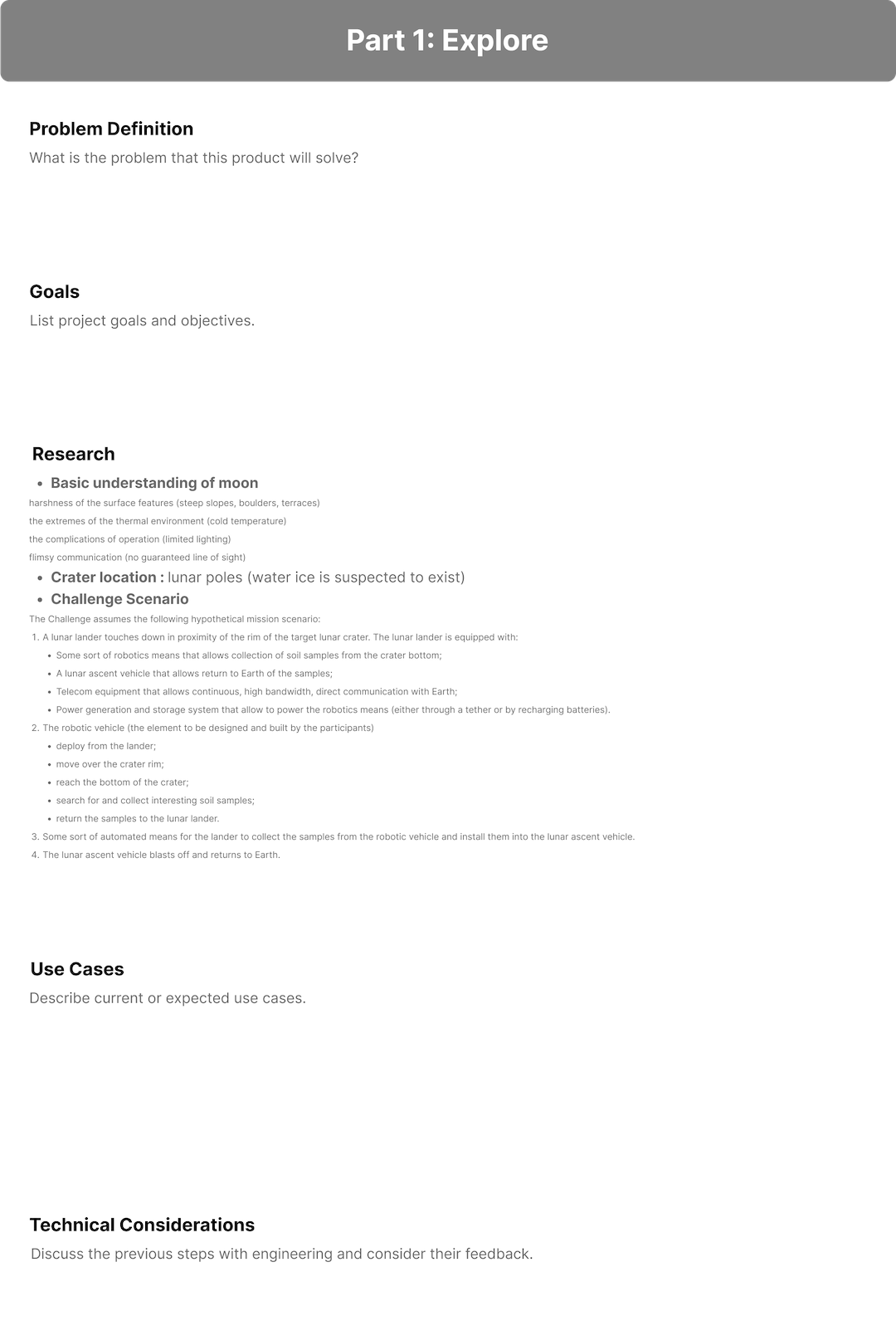
Goals: Create an engaging visualization that connects 3D context, route planning, and system data.
-
Research: Reviewed NASA rover missions and lunar surface challenges to ground the scenario.
-
Use Cases: Planned realistic interactions — viewing system KPIs, setting up routes, and monitoring exploration progress.
-
Technical considerations: Considered performance balance between 3D rendering and data readability.
This quick exercise gave the concept structure to see the bridge between imagination and feasibility, then I made the creative sprint feel both purposeful and playful.
Reflection
This Creative Friday reminded me how play can unlock better design instincts. By removing delivery pressure, we were able to focus on narrative, visual rhythm, and emotional clarity. Designing the Lunar Robot in Twin wasn’t about building a real tool — it was about exploring how interfaces can make data feel alive.
And maybe, in the process, learning a bit more about how to design for curiosity itself.
Key Takeaways
-
Creative play fuels innovation.
-
3D and data can tell a story together.
-
Internal experiments are powerful training grounds for design thinking.
Follow more on

Object-Oriented UX (OOUX) for digital twins: insights to support scalable 3D view


Designing SaaS for digital twin: how discovery shaped the solution
(47) 41 33 16 51
Reach Me By Phone
Email Me
Rølivegen 367, Steinkjer, 7718, Trøndelag
📍 Based in Norway