
From Problems to Priorities: Using the Opportunity Solution Tree to Align Core Teams
How I helped a product team reconnect around shared priorities and make smarter, outcome-driven decisions using the Opportunity Solution Tree framework.
Case Type: Product Discovery · Team Alignment
Tags: Opportunity Solution Tree, Strategy, UX Facilitation, Product Thinking
Time: 2023
Confidentiality Notice
This case study has been anonymised to comply with confidentiality obligations under the Company Personal Declaration of Secrecy. All product, team, and system names have been replaced or generalised. Visuals are shared privately for portfolio review only.
The Challenge
Too Many “Good Ideas,” Not Enough Focus
After a period of internal restructuring, our visualization product team faced a familiar challenge: too many promising directions and not enough clarity on priorities.
Each group had its own interpretation of what problem mattered most. As a result, the roadmap was packed with valuable but competing ideas — improvements, experiments, and feature requests that each felt urgent from different perspectives.
The problem wasn’t creativity; it was focus.
We needed a way to visualize shared priorities, connect them back to user and business outcomes, and make alignment visible across disciplines.
- Lack of a shared vision across UX, product, and engineering after re-org
- Too many “good ideas” competing for limited resources
- Unclear link between UX improvements and measurable business outcomes
- Pressure to deliver under reduced capacity

The Approach — Mapping Problems, Not Features
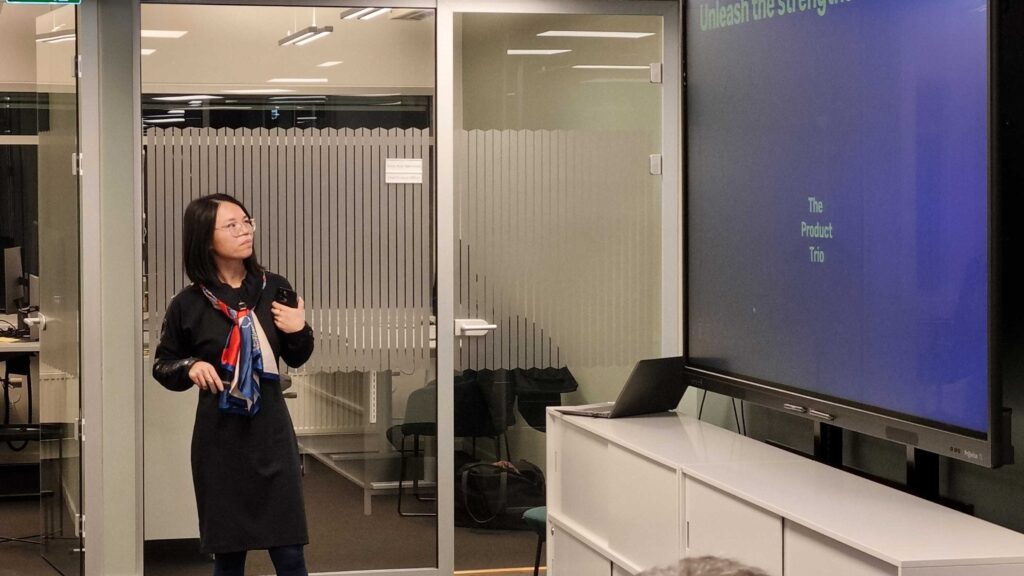
To rebuild clarity and collaboration, I introduced the Opportunity Solution Tree (OST) framework by Teresa Torres.
Instead of debating which feature to build next, we began mapping the landscape of opportunities — the real user problems worth solving — and tracing how each potential solution contributed to a larger goal.
We kicked off the session by revisiting our high-level objective:
“Help users make faster, more confident decisions in complex environments.”
Then, through a guided workshop, we worked backward:
- Identified pain points and recurring user feedback.
- Clustered them into opportunity themes.
- Brainstormed possible solutions and visualized how each connected to the goal.
- Scored impact vs. effort to surface the most meaningful next steps.
This exercise transformed our discussion from “what should we build?” to “which opportunity will deliver the most impact right now?”
Applying the OST Framework
I adapted the OST framework for our 3D View product — an enterprise digital twin visualization tool — to help the team identify what truly mattered to users and the business.
We started by defining a clear UX outcome:
“Improve Twin View usability for faster, more accurate task completion.”
From there, we mapped user frustrations (opportunities), potential design directions (solutions), and validation steps (experiments). Below are two examples of how we prioritized opportunities after discussing potential solutions with stakeholders.
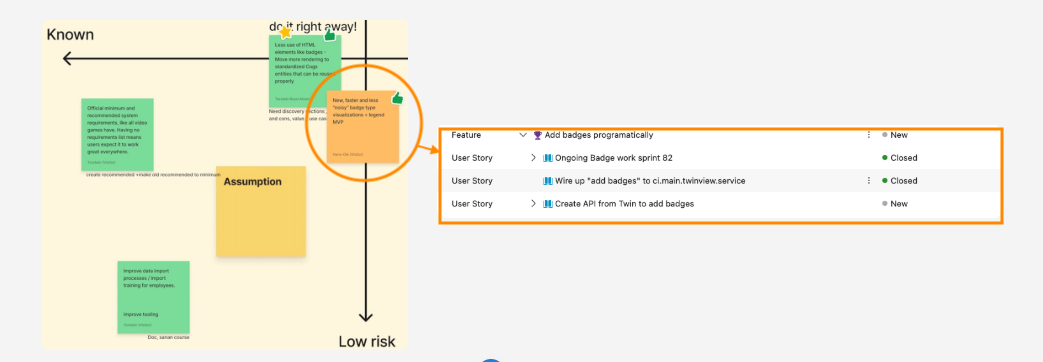
We used a Value–Risk Matrix to evaluate each idea — mapping initiatives by high value / low risk and high value / high risk. Every item went through multiple rounds of discussion, review, and iteration to ensure we were balancing innovation with feasibility. The Opportunity Solution Tree became a living document — evolving as our understanding deepened. We pivoted when new insights emerged, and that flexibility helped us keep alignment even as priorities shifted. Instead of chasing fixed plans, the team learned to focus on learning fast and delivering value continuously.
The Process
Each session included product managers, UX designers, Tech Lead, developer, and Vis director. We gathered findings from user feedback, support tickets, and internal testing to create our first draft tree in FigJam. By collaboratively clustering problems and opportunities, the team gained a shared understanding of where design could have the highest impact.
For example:
Users struggled to find assets in large 3D scenes → Opportunity: Improve search and annotation tools
UI clutter reduced task confidence → Opportunity: Refine visual hierarchy and standardize controls
Outcome
The Opportunity Solution Tree quickly became our decision-making anchor. It turned ambiguous discussions into concrete trade-offs.
- Prioritization improved — everyone could see which solutions tied directly to our UX outcomes.
- Cross-functional alignment strengthened — engineers, designers, and product leads shared the same visual roadmap.
- The team regained focus — moving from firefighting to intentional design iterations.
We take the low-risk, well-known post it, tune it to be a DevOps Story/Feature, depending on how big the topics are.

Reflection
The OST helped us shift from problem-driven to outcome-driven thinking. It wasn’t about building more features; it was about ensuring every feature moved us closer to our goal: helping users see, manage, and act seamlessly, anywhere.
When teams can visualize how every design decision supports the larger mission, alignment happens naturally — even after change.
Design leadership means creating clarity before creation.

Building the foundation: twin view system design document (SDD)
Product discovery: what-if scenarios for smarter decisions in digital twin
Designing for millions: Product Research on Taiwan’s NHI (National Health Insurance)App
(47) 41 33 16 51
Reach Me By Phone
Email Me
Rølivegen 367, Steinkjer, 7718, Trøndelag
📍 Based in Norway